

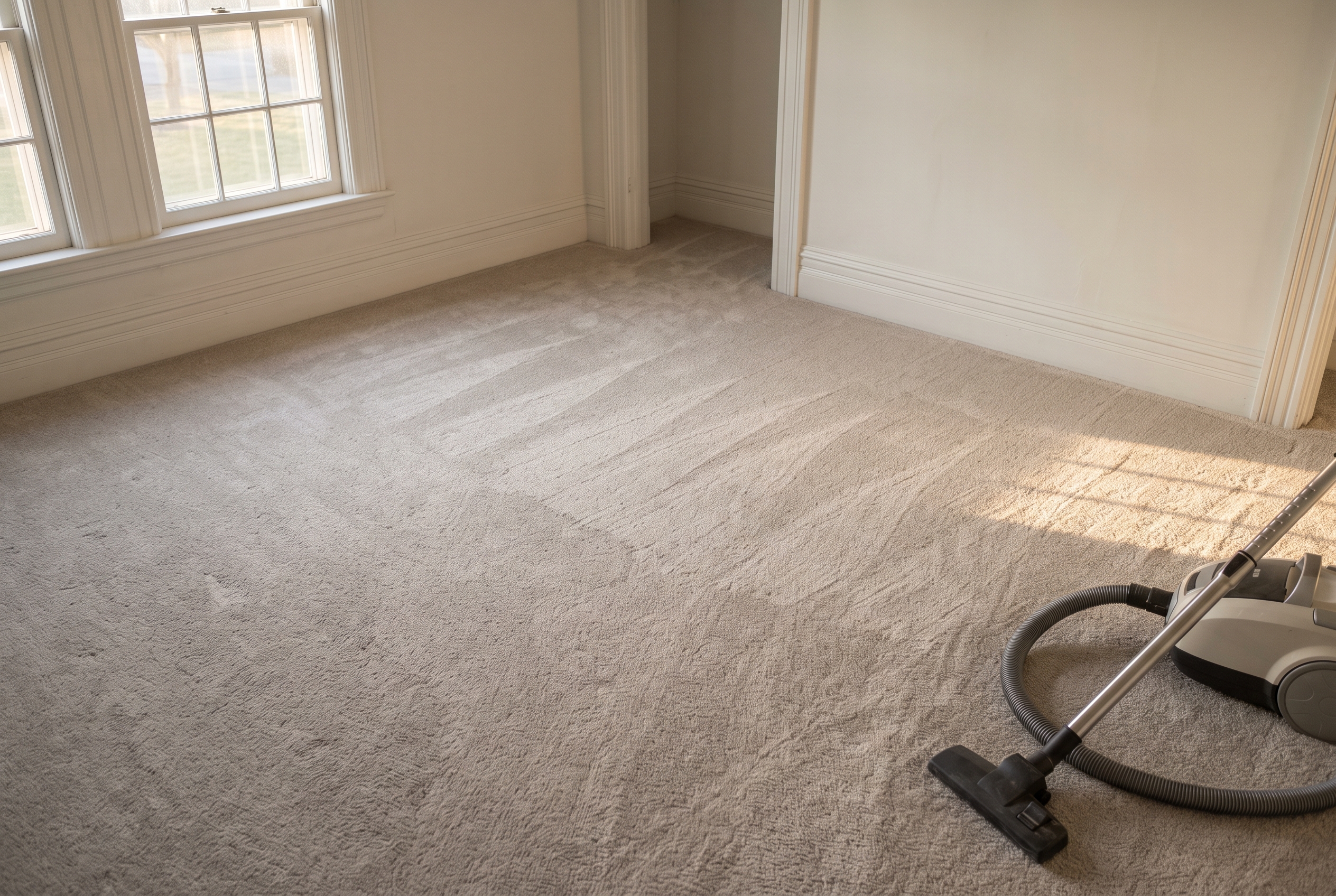
Most of what you notice in the first few weeks with new carpet is the carpet settling in, and it passes on its own. That covers the smell, the fuzz in the vacuum, a tuft standing up, a seam you can find in afternoon light and a band of flattened pile where the roll was stored. A ripple, a seam that opens, a color change that follows a seam or a smell that's still there after a month are the ones to call us about.
| What you notice | Normal? | Typical duration | What to do |
|---|---|---|---|
| A new-carpet smell | Yes | A few days, faint for up to two weeks | Windows open and the furnace fan running for three days |
| Short fibers filling the vacuum | Yes | A few weeks for synthetics, months for wool | Vacuum often with the brush set high |
| One tuft standing above the pile | Yes | Until you clip it | Snip it level with scissors |
| A seam you can see in side light | Yes | Softens over the first month | Vacuum along it instead of across it |
| Flattened bands across the room | Yes | Two to six weeks | Vacuum against the lay and steam it gently |
| Light and dark patches on a plush | Yes | Vacuums out, or stays for good | Vacuum with the lay of the pile |
| Footprints and vacuum tracks | Yes | Every time you vacuum | Nothing, it's the style |
| Static shocks in winter | Yes | Until spring | A humidifier set to 30 to 50 percent |
| A ripple or wave | No | Does not pass on its own | A week of dry air, then a call |
| A seam with a gap, a ridge or frayed edges | No | Does not pass on its own | Photograph it and call |
| A color step that follows a seam | No | Does not pass on its own | Call before the room gets heavy use |
| A smell still there after a month | No | Does not pass on its own | Look for moisture, then call |
What Should You Expect From New Carpet in the First Few Weeks?
Expect the first three days to be about fresh air and a close look. The first two weeks are when the smell and the loose fiber fade, and the first month is when seams and crush lines relax. By the third month, anything still wrong is a real problem and not the carpet settling.
Each stage gives the household one job, and none of them is hard. The order matters more than the effort, because the easiest fixes happen before the furniture is back and the rooms are in use.
What Happens in the First Three Days?
Open the windows and run the fan on your heating and cooling system for the first three days. That clears most of the new-carpet smell, and it costs you nothing but a cooler house in winter.
You can walk on a stretched-in carpet and put the furniture back the day it goes in, because nothing about a tack-strip installation needs time to set. A carpet that was glued down is the exception. Its adhesive needs the time the installer gives it before anything heavy sits on it or a vacuum pulls at it.
Use these days to look closely, in daylight, before the rooms fill up. Walk every seam, run a hand along the edges at the walls and doorways, and photograph anything that bothers you with the date on it. A ridge, a gap or a loose edge is quickest to put right while the room is still empty. A photo taken now also settles any later question about whether it was there from the start.
What Happens in the First Two Weeks?
By the end of the first week the smell is a faint trace you notice only when you come in from outside, and by the second week you'll have stopped noticing it. The vacuum is the surprise in this stretch. The canister fills with short fibers two or three times running, and it looks as if the carpet is coming apart.
It isn't coming apart, because those fibers are the trimmings left in the pile when the carpet was sheared at the mill, and once they're out they don't grow back.
Vacuum two or three times a week during these two weeks, with the brush set high so it skims the tips instead of digging in. Empty the canister when it's half full, because a full one stops pulling. The fiber coming up tapers off week by week, and the pile looks better after each pass.
What Has Settled by the End of the First Month?
A seam that stood out in the first week softens over the first month. The carpet relaxes into its stretch, and the pile on both sides of the seam gets walked and vacuumed the same way. The flattened bands where the roll was stored lift as the yarn recovers and takes on the room's humidity. Shaw, one of the brands we carry, gives a carpet a month or so to acclimate in its carpet installation guide, and that's about the span we see too.
Look at the floor again at the one-month mark, in the same light as your first look. A seam you can find by getting down to a low angle is a normal seam. A ridge you feel through socks, a gap you can see into or a band that's still flat after a month of vacuuming isn't settling. It won't settle, and that's the point to call us.
What Is Still Wrong by the Third Month?
By the third month a synthetic carpet has nearly stopped shedding, a wool carpet is still giving up a little, and the smell is gone. A ripple that's still there after a dry spell is a stretch problem. A smell that's still there is moisture. Light and dark patches that haven't vacuumed out are a permanent change in pile direction, and it has its own name and its own passage further on.
The one habit to start now is the clock on the first professional cleaning. Most makers want it inside the first 12 to 18 months, and the receipt is what a warranty claim leans on later. Nothing else about the carpet changes much after this point except the way you treat it.
How Long Does the New Carpet Smell Last, and Is It Safe to Breathe?
The new-carpet smell lasts a few days with the windows open, and yes, it's safe to breathe for a healthy adult in a room that's getting fresh air. It's strongest on the first day, and the faint traces are gone inside two weeks. The smell is the carpet, the pad, the seaming tape and sometimes the old carpet that just came up, giving off the last of what went into making them.
In the Carpet and Rug Institute's (CRI) carpet maintenance and troubleshooting bulletin, the airing is 48 to 72 hours with the windows and doors open and the heating and cooling system's fan on high. The EPA's page on carpet and indoor air gives the same 72 hours, with one caution. Ventilation cuts the emissions a great deal in those three days, but it doesn't take them to zero, so the last traces fade on their own over the following week or two.
Clearing it faster means moving air through the room. Open windows on two sides of the house if you can, run the bathroom and kitchen exhaust fans, and switch the furnace or air handler to fan-only so it runs all day. Keep the bedroom doors open so the carpeted rooms aren't sealed off, and skip scented sprays and candles, which add to the air instead of changing it.
In July, with the air conditioning running, leave the system's fan on so the air keeps moving, and open the windows in the cool of the morning and the evening. In an apartment with one window, a box fan in that window blowing out does more than a fan in the middle of the room.
What you're smelling is also what the Green Label Plus test measures. Green Label Plus is CRI's certification for low-emitting carpet, pad and adhesive. UL tests the samples in a sealed chamber under a method developed with the EPA, and the seal is the one to look for on any carpet, pad or glue that goes into a house. Shaw says every carpet it makes carries it.
The seal doesn't promise no smell on the first day. It means the carpet passed a low-emission limit, and a certified carpet aired for three days is as clean as the industry knows how to make it.
Can You Sleep in a Room With New Carpet on the First Night?
Yes, you can sleep in the room the first night with the window cracked and the door open, and you'll wake up to a faint smell and nothing else. The air in a bedroom with one window open changes over many times a night, and by morning the smell is already weaker than when the installers left.
An infant's room, a pregnancy, asthma or a chemical sensitivity changes the advice to two or three nights elsewhere while the room airs. Small lungs breathe faster for their size, and a sensitive airway reacts to concentrations an adult doesn't register. Give that room the full three days with a fan in the window blowing out and the door open, then move back in. A Green Label Plus carpet aired that way is the low-emission choice and the ventilated one at once, which is what the EPA asks for wherever people are sensitive.
What If the Smell Is Still There After a Month?
A new-carpet smell that outlasts a month is no longer the carpet off-gassing. It's almost always moisture, and the smell has usually changed from a sharp new-fabric note to something flat and musty. The usual sources are a basement slab giving up water vapor through the pad, a house closed up through a humid Long Island July without air conditioning, a pad that got wet in a spill and never dried, or a subfloor that was damp when the carpet went over it.
Find the water before you do anything else. Run a dehumidifier in the room until the air holds at about 50 percent, run the air conditioning in summer, and pull back a corner of the carpet at a closet wall to smell the pad. Dry pad smells like nothing, and damp pad smells like a wet towel.
Anything that got wet and dried inside two days is usually fine. A pad that has stayed damp for weeks is a call, because it needs to come up and dry, or be replaced, before it grows anything.
Is It Normal for New Carpet to Shed, and When Does It Stop?
Yes, a new cut-pile carpet sheds short fibers for weeks and sometimes months, and it's leftover from the mill, not the carpet wearing out. A cut pile is made by tufting yarn into a backing and shearing the tops level. The shear leaves trimmings down in the pile, and they work their way up under feet and the vacuum. Carpet made from spun yarn, where short fibers are twisted together like wool thread, sheds more than carpet made from long continuous filaments, and wool sheds longest of all.
Two facts help when the canister fills. Taking the loose fiber out does nothing to the carpet's life or quality, and the fibers are far too large to float in the air or be breathed in. CRI measures them at over 90 microns, where anything you could inhale is under four.
On how long it lasts, Shaw puts the fade at within a few months on its cut-pile carpet, with a little continuing for the life of the floor, and CRI's bulletin says most of it is gone within the first year with regular vacuuming. In practice a synthetic cut pile is down to a few strands a week after a month or two, and a wool carpet takes the better part of a year.
Vacuum often and gently, and let the fiber come. The fibers are already loose, so vacuuming less only means they come up on your socks instead. Shedding never looks like a thin spot, a patch where the backing shows through, or tufts coming out in clumps when you pull the vacuum back. Those are a call, and they're rare.
What Should You Do About a Tuft Standing Above the Pile?
Clip it level with the pile using sharp scissors, and never pull it. A tuft that stands up is called a sprout. It's a strand the shear missed or one that a vacuum brush or a pet's claw lifted, and it's still anchored in the backing. Pulling it drags the anchor out and opens a hole that never closes.
Hold the scissors flat against the surrounding pile and snip, then brush the spot with your fingers. One sprout at a time, now and then for the first few months, is normal. A row of loose tufts in a line, or sprouts appearing by the handful in one spot, is more than a sprout, and that spot is worth a photo and a call.
Why Is a Loop or Berber Carpet Fuzzing or Pilling?
Fuzz on a new loop carpet is the vacuum's brush roll, or a pet's claws, roughing up the tops of the loops, and it isn't shedding. A loop pile has no cut ends to shed. What it has is a surface a spinning brush can abrade until the loops look hairy, and that fuzz is damage, not settling.
Set the vacuum to suction only, or raise the brush until it barely touches the loops, and test it first in a closet where a mistake won't show. Shaw's carpet care guide says to try the brush bar somewhere inconspicuous before using it on the room and to use suction only on shag and long-yarn styles. The same caution serves a wool loop, which fuzzes more readily than a nylon one.
A single loop a claw has pulled up is clipped level like a sprout. A loop that keeps unraveling in a line across the carpet is called a zipper, and it's a repair. A well-made loop carpet is built so that one pulled loop doesn't run.
Are Visible Seams Normal in New Carpet?
Yes, visible seams are normal in new carpet. A properly made seam is tight, flat and sealed, and it's still a line where two cut edges meet, so you can find it if you look. CRI's residential installation standard, CRI 105, lists what a proper seam has. The edges are cleanly cut and sealed so they can't fray, and they butt tightly with no gap and no overlap. The pattern lines up where there is one, and the seam will not be invisible.
A new seam shows for reasons that fade. The pile on each side of the cut leans a little differently until it has been walked and vacuumed the same way, so one side reads darker. The stretch pulls the carpet over the seam tape and can leave a slight ridge, called peaking, that relaxes over the first weeks of use.
Light from a window across a seam makes any of this twice as visible, and a seam planned to run with the light shows least. Loop and Berber carpet show seams more than cut pile, because loops at two edges can't blend the way cut tips do.
Vacuum along the seam instead of across it, and let a month pass before you judge it. A seam you can see when you kneel and look toward the window is a normal seam, and you're the only person who will ever look for it.
Which Seam Problems Are Not Normal?
A gap you can see down into, an overlap where one edge rides over the other, edges that are fraying, a pattern that's off across the seam, or a ridge that catches a toe isn't a finished seam, and none of them settles. Each has a cause at the seam itself:
- A gap or an overlap means the two edges weren't butted tightly before the tape set.
- Fraying means the cut edges weren't sealed, and loose fibers along that seam will keep coming.
- A pattern that steps across the seam means the two pieces weren't matched before they were cut.
- A sharp ridge means the seam wasn't flattened as the tape cooled, or the tape sits off center.
The fix is to re-seam that run with fresh tape or to re-stretch the carpet across it, and either is a morning's work with the furniture pulled back. A stair is the seam most likely to fray, because the carpet is cut and fitted at every step and the nosing takes the wear. Photograph the seam with a coin beside it for scale, and call before the room is back in full use.
Why Does New Carpet Show Lines, Patches or a Different Color Than the Sample?
Lines across the room are roll crush, patches on a plush carpet are the pile leaning in different directions, and a color that reads different from the sample is the room's light on a whole floor. Each lifts, vacuums out or turns out to be the carpet you chose. The one exception is a sharp color change that follows a seam line, which is a mill matter.
Lines Across the Room Are Usually Roll Crush, and They Lift
Bands of flattened pile running across the width of the carpet are roll crush, the weight of the roll pressing on itself in the warehouse and the truck, and they lift. A nylon carpet usually recovers within a few weeks of ordinary vacuuming as the yarn takes on the room's humidity. Polyester and polypropylene take longer, because those fibers hold a crush the way a folded sweater holds a crease.
Help a band along by vacuuming against the lay of the pile. Then lay a damp white towel over it and hold a warm iron an inch above the towel, never on the carpet, for a minute at a time. A carpet rake lifts the pile where the band is stubborn.
Steam or a hot-water cleaning brings back any crushed pile that vacuuming alone won't, so a stubborn band on a polyester carpet usually gives up at the first professional cleaning. A band still flat at two months, on any fiber, is a call.
Light and Dark Patches on Plush Carpet Are Shading, Not a Color Change
Light and dark patches on a plush carpet are shading, and shading is a change in pile direction, not in color. Where the pile leans away from you it reflects light and reads pale. Where it leans toward you it absorbs light and reads dark, so the same patch is light from the window and dark from the door.
Solid-color cut pile shows it most, and textured and patterned styles hide it. CRI's bulletin calls shading a characteristic of the style and not a manufacturing defect, and every maker treats it the same way.
Most of it vacuums out if you finish each room with slow strokes all in one direction, with the lay of the pile. The patches close up for a few days until feet open them again. A patch that stays through months of vacuuming is pile reversal, also called watermarking or pooling, where the pile has turned and holds its new direction. It's permanent, nobody knows what causes it, and it changes nothing about how the carpet wears.
If the look bothers you, the honest fix is at the next purchase. A frieze, a textured or a patterned style hides the pile's direction, and a plush shows it.
Why Does the Color Look Different From the Sample?
A whole floor reads lighter and often cooler than the hand sample you chose from, or darker and grayer in a north-facing room with little direct light. There's a great deal more of it, and the room's light hits it from the side instead of from overhead. Pile direction adds to the effect, so the same carpet looks a shade different from each doorway, and the first time you see it installed you're seeing all of those at once.
Shaw's installation guide names lighting as the usual reason a new carpet looks different from the sample, and a month of living with it usually ends the question.
For the next room, judge color on a large sample laid on the floor, in the morning and again in the evening, against the wall color and the furniture that will sit on it. That's what a shop-at-home visit is for, because the samples come to your door and you see them where the carpet will live.
The one color question that isn't the light is a sharp step in color that follows a seam line, with one side of the seam a shade off from the other along its whole length. That's two dye lots, or a side-match difference from the mill, and it's a factory matter and not shading. Photograph it and call early, before the room has had months of use.
When Can You Vacuum New Carpet, and Which Vacuum Is Safe?
Vacuum a stretched-in carpet the day it goes in. A glued-down carpet waits for the adhesive, usually a day or two, and the installer who laid it tells you the figure for the glue they used.
The vacuum matters more in the first weeks than it ever will again, because the pile is new and the shedding is heavy. The vacuum to use carries CRI's Seal of Approval, which means it was tested for how much soil it lifts, how much dust it keeps inside and how little it changes the carpet's surface. The seal is on the box. Set it up for this carpet:
- Adjust the height so the brush just touches the tips of the pile. Too low and the brush fuzzes the yarn; too high and it lifts nothing. On a vacuum with no height setting, use the setting that lets it push easily, or the hose.
- Use suction only, or lift the brush off the pile, on a shag, a soft plush or a wool loop, and test the brush bar in a closet first on any carpet.
- Make slow, overlapping passes in one direction, then come back the other way.
- Empty the canister at half full while the shedding is heavy.
How often is the question we hear most. CRI's answer is daily in traffic lanes and pet areas, twice a week in rooms with ordinary use and weekly in rooms nobody uses much. In the first month, twice a week everywhere is the simplest rule and the one that ends the shedding fastest. A HEPA filter is a fine thing on a vacuum, but the seal measures dust containment, not the filter type, and certified vacuums reach it both ways.
When Can Furniture and Rugs Go Back, and How Do You Keep Dents Out?
Furniture goes back on a stretched-in carpet the same day, lifted into place and never dragged, because dragging a heavy piece across a fresh stretch is one of the ways a ripple starts. A glued-down carpet waits for its adhesive. Put cups or wide glides under the legs of the heaviest pieces so the weight spreads. Now and then, move the sofa and the bed a few inches so the same tufts aren't carrying the load all year.
A dent in the first weeks is normal on any carpet. Work the pile back up with the edge of a coin, vacuum over it, and if it's still flat use a little steam or a hot-water cleaning. A furniture dent that has sat for months responds to the same steps more slowly. Some deep dents under a very heavy piece never fully leave, and that's true of every carpet ever made.
A rug can go down on new carpet right away. Use a pad made for carpet over carpet, which has a rough face that grips the pile instead of a rubber one that grips a hard floor, so the rug doesn't creep. Lift the rug and vacuum under it now and then, because the pile under a rug isn't walked and will shade a little differently from the pile around it over a year.
How Should You Handle the First Spill on New Carpet?
Blot it with a clean white cloth or plain white paper towel, never rub it. Press into the spill and lift, then press again, working from the outside in, until the cloth comes up dry. Rubbing frays the tips of a brand-new pile and pushes the spill wider, and a colored cloth can leave its dye behind.
Try plain water first, blotted the same way, before any cleaner. If the spot stays, use a carpet spot cleaner that carries the Seal of Approval, follow its label, rinse with water and blot dry. Today's carpet comes with stain-resist treatments that let most spills come out when they're caught early, and a spill caught in the first minutes almost always comes out of a new carpet entirely.
Which Changes in New Carpet Are Not Normal?
A ripple or wave, an edge that lifts at a wall or a doorway, a seam that opens or frays, a line of missing tufts, backing showing through the pile, a color step along a seam and a smell that's still there after a month are the changes that aren't settling. Each has a cause and a fix, and none of them gets better by being lived with.
- A ripple or wave is humidity, a stretch that didn't take, a dragged piece of furniture or the wrong pad. It's re-stretched.
- An edge that lifts or feels hollow at a wall wasn't hooked onto the tack strip, or the strip let go. It's re-hooked, and the strip replaced if needed.
- A seam that opens or frays wasn't sealed or wasn't tight. It's re-seamed.
- A line of missing or short tufts, or backing showing in a patch, is a mill fault. It's a claim, and the carpet is repaired or replaced under it.
- A color step along a seam is a dye-lot or side-match problem from the mill. It's a claim.
- A smell past a month is moisture under the carpet. The water is found and the pad dried or replaced.
Photograph whatever you see in daylight, with a coin or a tape measure in the frame, and then leave it alone. Don't steam it, shampoo it or try to fix it, because a problem that's been worked on is harder to assess and harder to claim.
Call in the first weeks, not the first year. A ripple that gets walked on for months folds along its crest and wears there, and a worn crest can't be stretched flat again. Every one of these is easier to put right in an empty new room than in a lived-in one.
Why Would New Carpet Ripple in the First Weeks?
A ripple in the first weeks has one of four causes: humid weather, a stretch that didn't take, a heavy piece dragged across the carpet, or a pad too thick and soft for the carpet on top of it. Humid or damp weather can ripple a carpet for a while, and that ripple can leave on its own when the air dries. The other three stay until the carpet is re-stretched.
A humid Long Island July in a house without central air is the season for the weather kind, and a basement or a ground floor over a crawl space feels it most. Run the air conditioning or a dehumidifier in that room for a week before you judge the ripple. If it flattens, it was the weather, and keeping the room drier through the summer keeps it flat.
If it stays, it was never the weather. A ripple that stays is re-stretched with a power stretcher, which is half a day's work with the furniture out of the room.
Dragging furniture is the cause you can rule out yourself, because you know whether it happened. The pad is the cause you can't see. A pad that is too thick or too soft lets the carpet flex underfoot and work loose from its stretch. Both are fixed by re-stretching, and the pad is changed if it's the cause.
What Does a Factory Problem Look Like?
A factory problem is regular, and that regularity is how you tell it from settling. A line of missing or short tufts running straight across the carpet is a tufting needle that skipped. A color step along a seam is two dye lots. A pattern that runs off square across the room, so a row that starts level at one wall is an inch low at the other, was made off grain.
A pile that lifts away from its backing in a patch, so the carpet feels like two layers, has delaminated.
Each is a claim against the mill, and each is a repair or a replacement under the carpet's warranty. No vacuum or passage of time will touch it. Stop cleaning or treating the spot, and keep the paperwork that came with the carpet, because it carries the style, the color and the roll or dye-lot numbers a claim is built on.
The earlier it's raised, the simpler the claim, because a fault found before heavy use is plainly the mill's. Shedding, sprouts, shading, roll crush, footprints and a seam you can find on your knees aren't factory problems.
How Do Fiber and Carpet Style Change What's Normal?
If your carpet is a nylon plush, expect a little shedding, some shading and footprints, and the fastest recovery from a crush. If it's polyester or polypropylene, expect a crush to hold longer. If it's wool, expect the longest shedding and the gentlest vacuum. A loop or Berber barely sheds but shows seams more and fuzzes under a brush, and a frieze or a patterned style hides nearly all of these changes.
| Fiber | Shedding | Crush recovery | What else to expect |
|---|---|---|---|
| Nylon | Light, a few weeks | Fastest, within weeks | Static in a dry winter house |
| Triexta | Light, a few weeks | Close to nylon | Footprints on soft plush styles |
| Polyester | Light to moderate, a month or two | Slower, may need steam | Footprints and shading on soft plush styles |
| Polypropylene | Little, mostly in loop styles | Slowest, a crush can stay | Seams show more on its loop styles |
| Wool | Heaviest, up to a year | Good | Fuzz under a brush roll, so suction only |
Style matters as much as fiber. A plush or saxony, where every tuft is cut to the same height and stands straight, shows footprints, vacuum tracks, shading and roll crush, because its surface mirrors the way the pile leans. A frieze or twist, where the yarn is tightly twisted and kinks over, hides all of it.
A loop or Berber has no cut ends, so it sheds almost nothing and never shades, but its seams show more and a spinning brush can fuzz it. A patterned cut-and-loop hides footprints and shading and asks only that its pattern line up across every seam.
Which carpet you have is on the paperwork from your order. If it's wool, Anderson Tuftex's wool care page is the one to read, because wool sheds on its own schedule as the loose fibers work out, and it wants an approved vacuum. In our catalog, the Fiber filter sorts by nylon, polyester, polypropylene and triexta, so the next room can be chosen with the first weeks in mind.
Why Does New Carpet Shock You in Winter?
A new synthetic carpet in a heated house in January builds a static charge because the air is dry. Walking across a dry pile in rubber-soled slippers loads you up, and the doorknob discharges it. New carpet does it more than old because the pile is clean and upright and nothing has worn into it yet.
Humidity is the fix, and a humidifier that holds the room between 30 and 50 percent takes the shocks away. That range is also the one that keeps a house free of mold and keeps wood trim from shrinking. Leather-soled slippers help too, and many carpets carry an anti-static yarn in the pile. The shocks fade on their own when the heating season ends and the house takes on moisture again.
How Much Do Repairs Cost If Something Isn't Normal?
A re-stretch runs about $100 to $300 as a job in HomeAdvisor's carpet repair cost guide, with the first room at least $100 and each room after it $40 to $80. A seam repair is $100 to $250, and a patch over a damaged spot is $150 to $250. Most repair visits carry a minimum charge of $100 to $300 whatever the job, so one small fix costs about the same as two.
Loop and Berber carpet can run up to a quarter more to re-stretch, because the rows of loops have to stay straight as the carpet is pulled.
| Repair | Typical cost | What moves it |
|---|---|---|
| Re-stretching a ripple | $100 to $300 a job | Furniture to move, stairs, loop pile |
| Re-seaming | $100 to $250 | Seam length, a pattern to match, the fiber |
| Patching a damaged spot | $150 to $250 | Size of the spot, matching carpet on hand |
| First professional cleaning | $125 to $240 for a three-bedroom home | Rooms, stairs, pet treatment |
Put together, a ripple in one bedroom is a $100 to $300 visit. A bedroom ripple plus a hallway seam is closer to $200 to $550, because each job carries its own time and the furniture adds to both. Stairs add to any of them, since every step is worked by hand.
The first professional cleaning is the other cost of the first year. HomeAdvisor's carpet cleaning guide puts it at about $125 to $240 for a three-bedroom home, or $75 to $125 a room on a flat rate.
Not every repair is a bill. A mill fault, which is a line of missing tufts, a color step at a seam or a pile that lifts from its backing, is a warranty claim, and the carpet is repaired or replaced under it. A carpet we installed starts somewhere else again: we stand behind our work, so the first step is a call to us and not a repair quote.
How Do You Set Up a Care Routine That Keeps the Warranty Valid?
Vacuum on a schedule, book a professional hot-water-extraction cleaning every 12 to 18 months and keep the receipt, keep the booklet and paperwork that came with the carpet, and stop grit at the door. Most makers' wear and stain coverage assumes that routine, and the booklet is what a claim is checked against, so the receipts and the booklet live in the same folder.
- Vacuum daily in traffic lanes and pet areas, twice a week in rooms with ordinary use and weekly in rooms nobody uses much, with a Seal of Approval vacuum.
- Book the first hot-water-extraction cleaning inside 12 to 18 months of the install and every 12 to 18 months after, and keep every receipt with the booklet. CRI says a Seal of Approval cleaner or cleaning system is recommended and sometimes required by the maker.
- Put a rough mat outside every entry door and an absorbent one inside, and change them when they're full. Sand and road salt are the grit that wears a Long Island carpet, and a mat outside and one inside stop most of it at the door.
- Blot spills the day they happen with a white cloth, and use spot cleaners that carry the Seal of Approval.
- Move the heavy furniture a few inches twice a year, and keep the house in the same humidity range that stops the winter shocks.
None of this is special to new carpet. It's the routine every carpet wants, and the first weeks are when it's easiest to start. The one thing to do now that you can't do later is to keep the dye-lot and style numbers from the order with the booklet, because a claim or a matching repair years from now starts with them.
What Happens After We Install Your Carpet
At Carpet Depot, we install the carpet we sell, and the job ends with a walkthrough of every room and a clean-up, then care tips from us for the weeks after. Our installation crews are who you reach through us when something in your first weeks looks like a ripple, a seam or a smell that won't clear.
We stand behind our installations with a satisfaction guarantee, so the first call about any of it is to us and not to a repair service. Bring your photos and the paperwork from the order, and we'll tell you whether what you're seeing is the carpet settling or something to put right.
Our showrooms are in Levittown, Oceanside, Wantagh, Lake Grove and Patchogue, and we serve Brooklyn, Queens and the Bronx as well. When the first room has settled and you're ready for the next, a free in-home estimate measures it and prices it.
More Questions About the First Weeks With New Carpet
Can You Run a Robot Vacuum on New Carpet?
Yes, a robot vacuum is fine on new carpet from the first day, with one check. A suction-only robot is safe on any pile. A robot with a spinning brush roll gets the same closet test as an upright before it's let loose on a soft plush or a loop carpet, because a brush set too hard fuzzes the yarn. A robot also won't keep up with the heavy shedding of the first weeks, so let the upright do those passes and bring the robot in for the daily lanes afterward.
Why Does New Carpet Show Footprints and Vacuum Marks?
A plush or saxony shows every footprint because its pile stands straight up and bends under a foot, and the bent tufts catch the light differently from the ones around them. It's the style, not a fault, and a frieze or a textured carpet doesn't do it. The marks lift when you vacuum and come back when you walk, for the life of the carpet.
Should New Carpet Be Steam Cleaned in the First Year?
No, a new carpet doesn't need a steam cleaning in its first year unless a spill reached the pad. A stretched-in carpet can take a hot-water-extraction cleaning at any time, but the first scheduled one is the 12-to-18-month cleaning that most warranties ask for. A glued-down carpet waits at least for its adhesive to cure fully, which the installer tells you. In the meantime, vacuuming does more for a new carpet than any cleaning machine.
Is New Carpet Bad for Allergies?
No, new carpet isn't bad for allergies as long as it's vacuumed. A carpet's effect on indoor air is to hold dust and pollen until a vacuum lifts them out, and the EPA's carpet page makes the same point. Kept clean from the day it goes in, carpet traps a great deal of what would otherwise circulate, and only a neglected carpet gives it back. The vacuuming you do for the shedding in the first weeks is the allergy routine too, and a Green Label Plus carpet keeps the emissions side low.
Can Pets Walk on New Carpet Right Away?
Yes, pets can walk on new carpet right away. If the smell worries you, keep the dog out of the room for the first day of airing, then let them in. Trim claws that catch in a loop carpet, and treat an accident like any spill: blot, water, a Seal of Approval spot cleaner, and dry it the same day.
Why Does New Carpet Feel Stiffer or Softer Than the Sample?
A sample on a board has no pad under it and has been handled by every customer before you. The floor has your pad under it, which changes the feel more than the carpet does, and the pile softens as it acclimates to the house over the first month. The carpet you have at the end of that month is the one you bought.
Why Are There Dark Lines Along the Walls of a New Carpet?
Dark or grayish lines along the walls, on stair edges and under doors are filtration soiling, and they're the house's air, not the carpet. Air moving through the gap under the baseboard leaves fine soot and dust on the pile edge. That soil needs a professional cleaning's chemistry to lift, and sealing the gaps under the baseboards and changing the furnace filter slows it down.
Plan the Next Room With a Free Estimate
Once the first room has settled and you know how new carpet behaves in your own house, the next room is easier to choose. You'll know whether you want a style that hides footprints, a fiber that springs back faster, or a color you've already seen under your windows. A free in-home estimate measures the next room and prices it, and the samples come with us.


