

Refinishing hardwood floors usually takes three to five working days. Sanding fills the first day, a stain color adds a day, and the coats of finish take one or two more. A single room left its natural color with a water-based finish can be done in two days. After the last coat, the type of finish decides how soon you can walk on the floor, bring the furniture back and lay the rugs down.
| Milestone | Water-based finish | Oil-based finish |
|---|---|---|
| Working days in the house | 2 to 4 days | 4 to 5 days |
| Coats applied in one day | Two, sometimes three | One |
| Walking in socks | 24 hours after the last coat | The morning after the last coat |
| Light furniture back | About 3 days after the last coat | 2 days, or longer if the label says so |
| Rugs back | About a week after the last coat | About a month after the last coat |
What Happens on Each Day of a Hardwood Refinishing Job?
A refinishing job always runs in the same order: sanding, stain if you want a new color, a sealer coat, two or three topcoats, then drying time. The rooms in the job stay closed from the first pass of the sander until the last coat is dry. For most of the week, you live in the rest of the house and go around the work.
The schedule below is for a typical first floor, such as a living room, a dining room and the hall between them, sanded, stained and given three coats of water-based polyurethane.
| Day | Work on the floor | Rooms you can use |
|---|---|---|
| Day 1 | Doorways sealed and first sanding passes | Every room outside the job |
| Day 2 | Final sanding, stain samples and stain | Every room outside the job |
| Day 3 | Sealer and the first topcoat | Every room outside the job |
| Day 4 | A light sanding and the last topcoat | Every room outside the job |
| Day 5 | No work while the finish dries | The new floor, in socks |
An oil-based finish stretches the middle of that week. Each coat needs most of a day to dry, so three coats fill days three, four and five, and the floor is ready for socks on day six.
On Day One, the Rooms Are Sealed Off and Sanding Starts
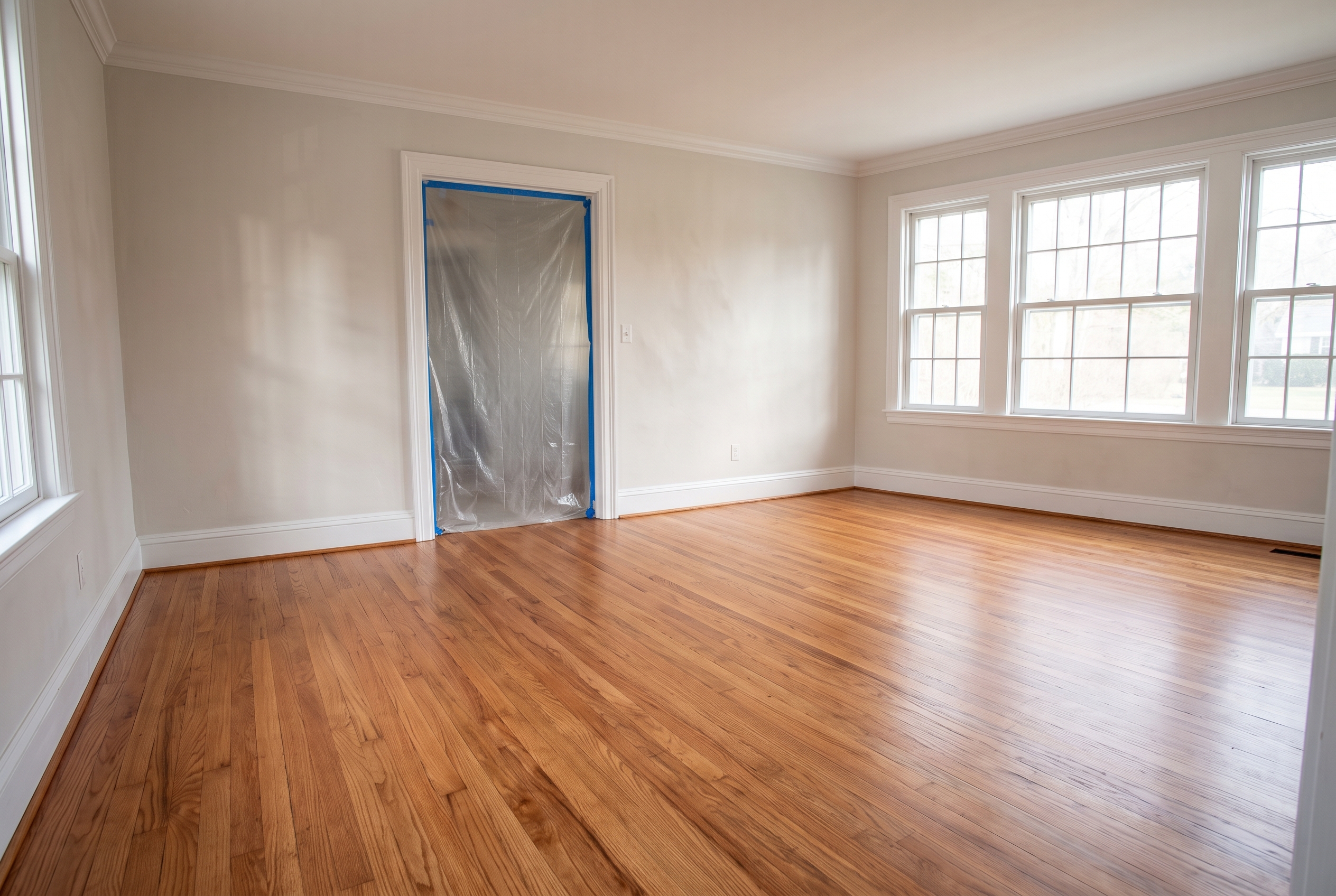
Sanding starts on day one and takes most of the day for a typical first floor. The furniture has to be out of the rooms before the first pass. Plastic goes over the doorways to the rest of the house, and the heat and air vents in the work area are covered.
The fan on the heating and air conditioning system is switched off so dust can't travel through the ducts. Shoe molding at the base of the walls comes off where it's in the way. Nail heads sticking up are tapped below the surface, because a sander that catches one tears its paper and gouges the board.
Then a big drum or belt sander cuts through the old finish with coarse paper and levels the boards. A smaller edging sander follows along the walls, into the corners and under the radiators, and each pass uses finer paper than the one before.
The work is loud and steady all day. By evening you'll see pale, bare wood behind the plastic. Keep the bedroom and closet doors near the work closed, because fine dust finds its way everywhere.
Day Two Is When the Sanding Ends and You Pick the Stain Color
Day two finishes the sanding, and if you're staining, it's the day you choose the color on your own floor. The last pass uses the finest paper. A buffer then goes over the whole floor to blend the marks left by the big sander and the edger. Last, the floor is vacuumed and wiped until no dust is left in the grain.
Stain samples are brushed onto the bare wood in a few spots. The same stain looks different on red oak than on white oak, and different again depending on how fine the sanding was, so a chip in a store can't tell you how your floor will look. Look at the samples in daylight and again with your evening lamps on.
For a deep, even color, the floor may be water-popped first. It's lightly wetted so the grain opens up and takes the stain more evenly, and that adds a few hours of drying before the stain goes on.
Stain must be completely dry before any finish goes over it. A fast professional stain can take a topcoat in two or three hours in normal room conditions. Dark colors, water-popped floors and humid weather all slow it down, and an oil-based polyurethane needs extra drying time over stain. In practice, the stain dries overnight and the coats start the next morning.
If you're keeping the floor's natural color, the stain step drops out of the schedule, and the first coat can go on the day the sanding ends.
Days Three and Four Are for the Sealer and Topcoats
The finish goes on in layers over days three and four: a sealer coat and two or three topcoats. First comes the sealer coat, which soaks into the wood and helps the rest of the finish go on evenly. Then come the topcoats, which build the clear film you'll actually walk on. Each coat is spread from the far wall back toward a doorway, so nobody has to step on wet finish.
A water-based polyurethane dries in two to three hours a coat in good conditions, so two coats often go on in one day. An oil-based polyurethane needs about eight to ten hours, so it's one coat a day.
Between coats, the floor is vacuumed and wiped, and it's usually given a light pass with a fine sanding screen. That smooths out dust specks and helps the next coat grip. A coat put on top of one that's still soft can stay tacky, turn cloudy or peel later, so the drying time between coats is the part of the job that can't be rushed.
Keep the rooms closed during these days and leave the thermostat at a normal living temperature. A window open in another room keeps fresh air moving, but a fan pointed at the wet floor blows dust into it. After the last coat, the door stays shut overnight. When you open it the next day, the sheen will look even, the smell will be fading, and you can walk on the floor in socks.
How Does a Water-Based or Oil-Based Finish Change the Schedule?
If you need the rooms back quickly or want to keep the wood's pale color, a water-based polyurethane is the finish to choose. Its coats dry in hours, two go on in a day, and its smell is mild. If you love the warm, amber look of a traditional oak floor, an oil-based polyurethane gives you that, and you plan around a coat a day and a month before the rugs go back.
The National Wood Flooring Association (NWFA) describes water-based finishes as normally clear, very durable and quick to dry in its homeowner guide to wood floor finishes. It describes oil-based finishes as amber in color and very durable. That amber tone shows from the first day on a light floor and deepens over the years. A water-based finish leaves the wood close to the color it was after sanding or staining, which suits a pale, gray or natural look.
A few other finishes come up, and each has its own schedule printed on its label.
- Two-part water-based finishes have a hardener mixed in on site. They cure faster than one-part water-based finishes, in about three days instead of about five.
- Moisture-cured finishes and conversion varnish, which is often called a Swedish finish, are specialty finishes built for very hard wear. They're less common in homes.
- Hardwax oils and penetrating oils soak into the wood and harden there, and later on they're refreshed with more of the same oil.
The sheen is a separate choice, and it doesn't change the timeline. A matte finish hides scratches, pet hair and dust better than satin, and gloss shows the most.
When Can You Walk on Refinished Floors, Put Furniture Back and Lay Rugs?
You can walk on a refinished floor in socks 24 hours after the last coat of a water-based finish, or the next morning with an oil-based one. Furniture goes back after two or three days and rugs after a week to a month, depending on the finish. The gap between those waits is the gap between a dry finish and a cured one.
A dry finish no longer takes a fingerprint. A cured finish has reached its full hardness, and until it does, it dents, scuffs and marks more easily than it ever will again. Every wait after the first day protects a finish that is dry on top and still hardening underneath.
With a water-based polyurethane, wear socks for the first day or two, then shoes. Light furniture can go back about three days after the last coat. Rugs wait until the finish has fully cured, which takes three to five days for most professional water-based finishes and about a week for some, so plan on a week.
An oil-based floor takes shoes after a couple of days. Its labels agree on a month before rugs but differ on furniture: some allow light pieces back after two days, and others say to wait the full month.
If your label falls in between, set chairs and side tables back after two days and the sofa, beds and dressers after a week. Keep the piano, the refrigerator and anything very heavy off the floor as close to the month as you can. Whatever the finish, the label on the product used on your floor has the final word, so know which finish your floor is getting before you plan the move-back.
Light Furniture Goes Back Before the Heavy Pieces
Furniture goes back lightest first, and every piece is lifted into place, never slid. A finish that's still curing takes a scrape from a chair dragged a few inches and a dent from a dresser foot set down hard, and those marks stay in the finish after it cures.
- Put felt pads on every leg before the piece touches the floor, including the feet of beds and sofas.
- Bring back chairs, side tables and lamps first.
- Carry in beds, sofas, dressers and bookcases next, with two people on each piece.
- Move pianos, refrigerators, safes and full china cabinets last, on hardboard or sliders made for wood floors, and lower them gently.
- Swap hard plastic wheels on desk chairs for soft ones, or put down a chair mat once the floor has cured.
If the kitchen floor was refinished, the refrigerator and range go back on sheets of hardboard laid in a path from the doorway. Roll them only on the boards, and pull the boards out last.
Why Do Rugs Have to Wait Longer Than Furniture?
Rugs wait longer because a rug covers the finish while it's still hardening, and a finish needs air to cure. Under a rug or a pad, the finish cures more slowly than the floor around it, and a pad can press its pattern into the soft finish or leave a mark the shape of the rug. That's why a water-based floor waits about a week for its rugs and an oil-based floor about a month.
When the rugs go back, use a pad made for finished wood floors, such as felt or felt with a natural rubber face. Avoid pads and mats with a vinyl or plastic backing, which can stick to a wood finish or discolor it. If you need something in a busy hallway before the month is up on an oil-based floor, a breathable cotton runner without a pad does the least harm.
When Can Dogs and Cats Walk on a Newly Refinished Floor?
Dogs and cats can walk on the new floor once it takes shoes, which is two or three days after the last coat with either finish. For the first couple of weeks, keep running and sliding to a minimum, because a dog scrabbling for grip on a soft finish leaves claw marks that the same floor would shrug off a month later.
Trim their nails before they come back, and lay a washable runner along the path they use most. Put the food and water bowls on a tray or a mat without a rubber or vinyl backing. During the job itself, keep pets in a closed room away from the work, or with friends or family, especially on the days the finish goes on.
How Should You Clean the Floor in the First Weeks?
For the first week, clean a newly refinished floor only with a dry dust mop or a vacuum on its bare-floor setting. Water and cleaners on a finish that's still curing can dull it or leave a haze, so wait until the finish has cured before you damp-mop.
After that, use a cleaner made for the finish on your floor, sprayed lightly onto a microfiber mop instead of onto the floor. Wet mops and steam mops are never right for wood. For the long run, everyday hardwood care means a dry mop most days, felt pads under the furniture and a lightly damp mop with a hardwood cleaner about once a month.
Can You Stay in Your House While the Floors Are Refinished?
Yes, you can usually stay home during a refinishing job, as long as the rooms in the job aren't your only way to the kitchen, a bathroom and the bedrooms. A water-based job on one floor of a two-story house is the easiest to live through. Plan to stay somewhere else on the coat days of an oil-based finish, and whenever the job cuts off your only bathroom or your kitchen.
The sanding days are noisy and dusty in the work area, but the rest of the house is livable behind the plastic. The coat days are harder, because the rooms being finished are completely off-limits and the smell of the finish spreads through the house for a while.
You can usually sleep at home on the sanding nights. On the nights after a water-based coat, sleep upstairs or at the far end of the house with the bedroom windows open. On the nights after an oil-based coat, sleep somewhere else if you can, because the smell is stronger and lasts longer.
How Do You Get to the Kitchen and Bathroom During the Job?
Plan your route before the job starts, because nobody can cross a wet floor and each room is finished toward its exit. In a two-story colonial, the usual answer is to live upstairs while the first floor is done. That works as long as the stairs and front hall aren't in the job and you can get in and out of the house without crossing the new floor.
A one-level ranch or a Cape is harder, because the living room, hall and kitchen are usually one connected floor. If the job includes the hall to the bedrooms, doing it in two halves keeps a route open while each half dries, and that adds two or three days to the schedule.
Before the coat days, set up a temporary kitchen in a room outside the job, with a coffee maker, a microwave and a cooler. Make sure everyone can reach a bathroom without stepping on the floor. If the only bathroom is behind the work, those are the days to stay elsewhere.
Who Should Stay Somewhere Else While the Finish Goes On?
Anyone who has asthma, is pregnant or gets headaches from paint smells should be somewhere else on the days the finish goes on and the day after. Infants and pets should be out of the house too. Older children and adults without those sensitivities usually do fine at home on water-based coat days, with the windows open.
Floor finishes give off fumes as they dry, and oil-based polyurethanes give off far more than water-based ones. Their labels tell you to open windows for fresh air and to leave the area if your eyes water or a headache starts.
The EPA's page on volatile organic compounds and indoor air quality lists varnishes among the household products that release these compounds while they're in use. Its advice is to increase ventilation and follow the label's precautions. In practice, that means open windows in the rooms next to the job and an exhaust fan running when the weather allows.
Oil-based finishes can also catch fire while they're wet, and their labels say to keep them away from sparks and open flames. If your floor is getting an oil-based finish, turn off the pilot lights on any gas appliances near the work. Don't light candles or the fireplace until the coats are dry and the smell has cleared.
How Should You Prepare Your Home for Floor Refinishing?
To prepare your home for floor refinishing, clear the rooms in the job, plan a route around them and decide where everyone will be on the coat days, starting about a week ahead. The furniture has to be out of the rooms before the first sanding pass, and the small things are yours to clear.
- Clear the closet floors in the rooms being done, and take down curtains that touch the floor.
- Take down pictures, mirrors and shelves in the rooms being sanded, or at least the fragile ones, since sanding shakes the walls a little.
- Pack a temporary kitchen if the kitchen is in the job or you can only reach it through the work.
- Paint walls and ceilings before the floors are refinished, and leave the baseboards for a touch-up afterward. Painter's tape doesn't go on the new finish until it has cured.
- Finish other work that sits on the floor first. In a kitchen, the cabinets and island are usually in place before refinishing, so the finish runs right up to them.
- Decide where the pets and kids will be, especially on the coat days.
- Set the thermostat to a normal living temperature and leave it there for the whole job.
- Leave the driveway or the curb in front of the house open for the crew's equipment, and clear a path from the door to the work.
- Take photos of where everything stood, so the rooms go back together quickly.
What Adds Days to a Refinishing Schedule?
A bigger floor, a floor in rough shape, and the choice of a stain or an extra coat are what usually add days. A whole first floor takes longer to sand than a bedroom, and a floor with deep scratches, pet stains or gray, worn paths where the finish is gone needs more sanding before the wood is clean.
- Damaged boards have to be repaired or replaced before sanding, and the patch is sanded flat with the rest of the floor.
- Stairs are sanded mostly by hand, one tread and riser at a time, so a staircase often adds most of a day.
- Borders, inlays and parquet have wood running in more than one direction and need more careful sanding.
- An old wax finish has to come off completely, because new polyurethane won't stick to wax.
- A stain color adds about a day, and a dark color or a water-popped floor can add more.
- An extra coat in a busy kitchen or hallway adds a few hours with a water-based finish and a day with an oil-based one.
- A cold or humid house slows every coat.
Does a Long Island Summer or Winter Change the Schedule?
Yes, a humid Long Island summer can add a day, while a heated winter house usually keeps the job on schedule. On a muggy August day, the air in a house without the air conditioning on stays damp enough that each coat dries much more slowly. A coat put down too soon over a slow one can turn cloudy.
Keep the house between about 65 and 80 F during the job, and run the air conditioning or a dehumidifier when it's humid outside. In winter, a heated house has dry air, which helps the finish dry, but a cold house slows it down, so leave the heat at a normal setting while the coats dry. Spring and fall, when the windows can be opened and the air isn't heavy, are the easiest seasons.
The wood also moves with the seasons. Boards swell a little in humid summers and shrink back in dry winter air. A floor refinished in August may show thin gaps between boards by February, and that's normal movement, not a problem with the finish.
How Much Does It Cost to Refinish Hardwood Floors?
HomeAdvisor's cost guide for refinishing hardwood floors puts the job at about $3 to $8 a square foot, with the average project around $1,900. Staining adds about $1 to $3 a square foot. A single small room costs more per square foot than a whole floor, because the setup, the travel and the equipment cost the same either way.
| Part of the job | Typical cost |
|---|---|
| Sanding and refinishing | $3 to $8 a square foot |
| Stain added to the job | $1 to $3 a square foot |
| A 600-square-foot first floor, unstained | $1,800 to $4,800 |
| The same first floor, stained | $2,400 to $6,600 |
| Replacing damaged boards | $6 to $12 a square foot |
| A screen and recoat | $1 to $2.50 a square foot |
HomeAdvisor puts stairs and railings at about $4.50 to $8 a square foot. Dustless sanding equipment, which pairs the sander with a large vacuum, adds about $2 a square foot, and moving furniture costs about $20 to $50 a room when it's done for you. The things that add days usually add dollars too: stairs, board repairs, a stain and an extra coat.
Refinishing a floor that's still sound usually costs less than tearing it out and putting in a new floor of similar quality. We price your job at the assessment, once we've seen the boards, measured the rooms and talked about the stain and finish.
A Screen and Recoat Takes a Day or Two When the Floor Is Only Dull
When the finish is dull and scratched but hasn't worn through to the wood, a screen and recoat can bring the floor back in a day of work. The floor is cleaned, the old finish is lightly sanded with a fine screen, and a fresh coat goes on top. NWFA calls this a maintenance coat and recommends one every three to five years. After the coat, the waits are the same as after the last coat of a full refinish.
A recoat can't fix deep scratches, dents, gray worn paths or water and pet stains in the wood, and it can't change the color, because those problems are below the finish. Those floors need the full sanding. A recoat also needs a floor free of wax, polish and oily residue, since a new coat won't stick to any of them. A factory-finished floor is tested first to see whether a new coat will hold.
To see which one your floor needs, look at the busiest paths in good light. If the finish is dull and full of fine scratches but the wood underneath still has its color, a recoat is likely enough. If you see gray, bare-looking wood, dark stains or scratches that catch a fingernail, the floor needs a full sanding.
What Should You Do If the Finish Doesn't Look Right After a Few Days?
A new finish that feels tacky, looks cloudy in patches or has marks in it usually shows it in the first week. Moisture, cold or something set on the floor too soon is the usual cause. Find the cause before you try a fix, because a cleaner or polish on a finish that's still curing makes most of these worse.
A floor that's still tacky a day or two after the last coat was probably slowed down. A cold or humid house, still air, a heavy coat or stain underneath that hadn't fully dried are the usual reasons. Warm the house to a normal temperature, run the air conditioning or a dehumidifier, keep air moving through the house without a fan blowing on the floor, and give it another day. A finish that's still soft after the cure time on its label needs to be looked at before anything goes on it.
Cloudy or white patches usually mean moisture got trapped in a coat, from a humid day or from a coat laid over stain or sealer that wasn't dry. A haze in the top coat can often be fixed by lightly sanding that coat once it's dry and putting on a new one. A haze that runs through several coats means sanding down to the wood again.
Dust specks are normal in small numbers in a floor finished in a lived-in house. Bubbles and specks you can feel with your hand are sanded out with a fine screen and covered with a fresh coat.
Dents, scuffs and rug marks come from furniture or rugs going down while the finish was still soft. A rug mark often fades after the rug is lifted and the floor gets some air, and scuffs that stayed in the finish come out with a recoat after the floor has cured. A dent that went into the wood needs sanding. Claw scratches from a pet on a new floor are usually in the finish only, so a recoat after the cure takes care of them too.
Peeling or flaking means the finish didn't stick to the floor, most often because wax, polish or another coating was left on the wood. It's fixed by sanding the area back to bare wood and refinishing it. Don't try to cover any of these problems with a polish, a floor restorer or a cleaner, because each one leaves a film that a new coat won't stick to.
What Happens When We Refinish Your Floors
At Carpet Depot, we refinish hardwood floors in homes across Long Island, and every job starts with an assessment at your home. We look at the condition of your floors, talk through what you want them to look like and recommend what the floor needs.
When the work starts, we prepare your space so your home and belongings are protected from dust and debris. We sand the floors to remove the old finish and smooth out imperfections, apply the stain of your choice, whether that's the floor's original color or something new, and finish it with a high-quality protective coat. When the job is done, we inspect the floor and give you maintenance advice so the new finish lasts.
Our five showrooms are in Levittown, Oceanside, Wantagh, Lake Grove and Patchogue, and our mobile shop-at-home service covers Brooklyn, Queens and the Bronx. If you'd rather pay for the project over time, special financing is available, subject to credit approval.
More Questions We Hear About Refinishing Timelines
Can You Refinish One Room at a Time?
Yes, a single room can be refinished on its own, and it's the quickest kind of job. Stop the new finish at a doorway or a threshold, where the floor already has a natural break. A freshly refinished room next to an older finish rarely matches perfectly in color or sheen, and a doorway hides the line.
Can Hardwood Floors Be Refinished in One Day?
No, hardwood floors can't get a full sanding, stain and three coats in one day with ordinary finishes, because each coat needs its drying time. Jobs advertised as one-day use finishes that are cured on the spot with ultraviolet light, or they're a recoat without sanding. Even then, the rug and furniture waits for the finish still apply.
How Long Does the Smell Last After Floors Are Refinished?
A water-based finish has a mild smell that usually fades within a day or two with the windows open. An oil-based finish smells stronger and longer, often for several days, and the smell lingers longest in a room that's kept closed. Fresh air through the house is the fastest way to clear it.
Do Engineered Hardwood Floors Take as Long to Refinish as Solid Ones?
Yes, an engineered floor with a top layer thick enough to sand goes through the same steps and the same waits as a solid one. The top layer of real wood is thinner, though, so it's sanded more carefully and can be sanded fewer times over the life of the floor.
Is It Better to Refinish Floors Before You Move In?
Yes, an empty house is the easiest place to refinish floors, because nobody has to live around the work. With a water-based finish, have the last coat down at least a week before the movers arrive. With an oil-based finish, aim for about a month if the rugs and the heaviest pieces are coming on moving day.
Pick Refinishing Dates That Leave Room for the Waits
The working days are the easy part of the schedule. Count back from the day you need the rooms with the furniture and rugs in them, add the waits for the finish you're choosing, and leave a couple of spare days for a humid week. When you're ready, we'll come look at your floors, talk through the stain and finish, and price the job.


