

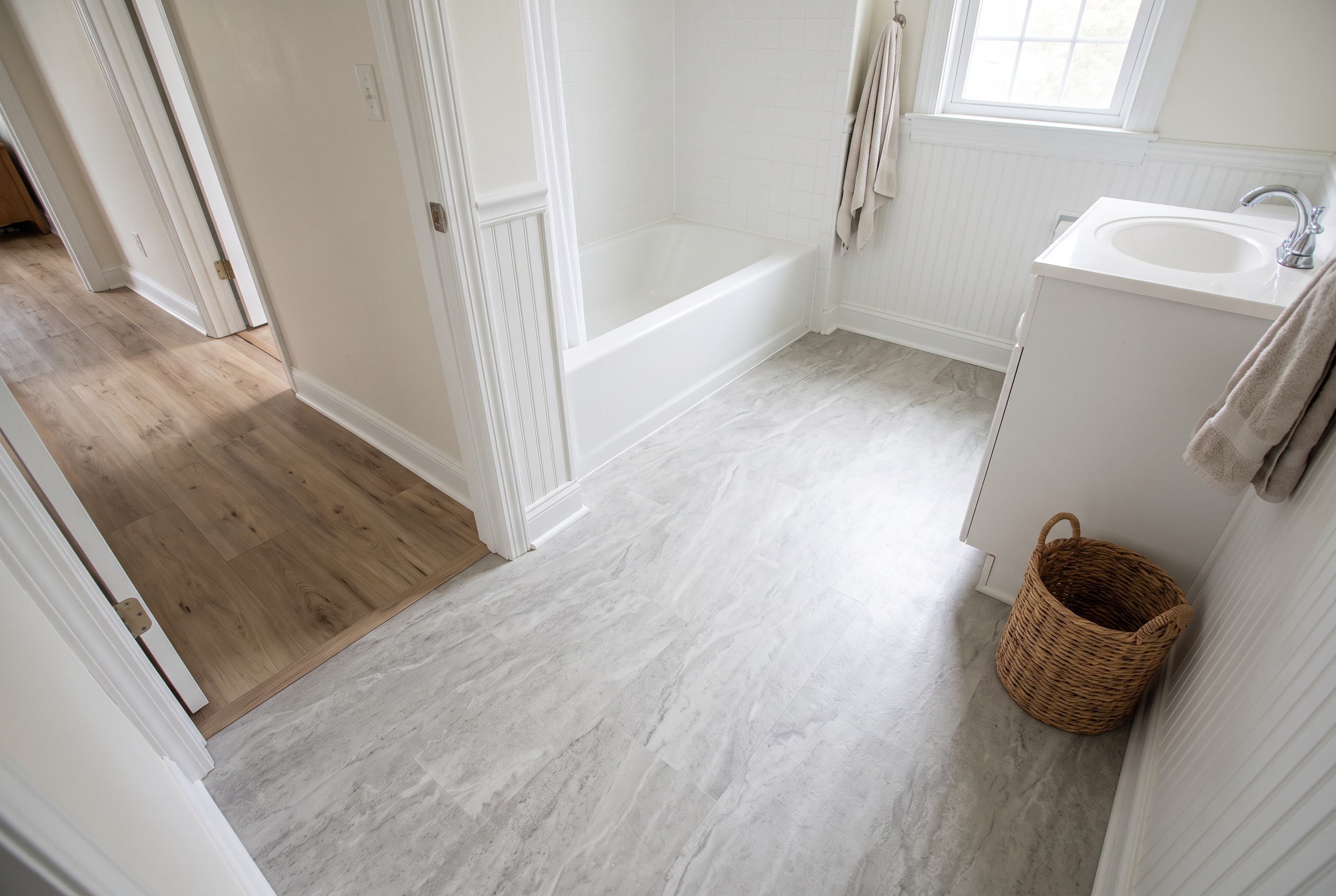
Sheet vinyl is usually the better floor for a small bathroom, a laundry room or a closed kitchen on a tight budget. One piece can cover the whole room with no joints for water to find, and it costs less. Luxury vinyl plank is usually the better floor for a kitchen that opens into living space, a busy entry or a whole first floor. It's also the one to choose when you want a wood look and the option of replacing one damaged board.
| Room | Usually the better pick | Why |
|---|---|---|
| Small bathroom | Sheet vinyl | One piece with no joints by the tub |
| Laundry room | Sheet vinyl | No joints under the washer |
| Closed kitchen on a budget | Sheet vinyl | Lower cost and few seams |
| Kitchen open to living space | Vinyl plank | Runs on like a wood floor |
| Basement on a dry slab | Either one | Both handle concrete |
| Mudroom or busy entry | Vinyl plank | Thicker wear layers for grit |
| Whole first floor | Vinyl plank | No seams across doorways |
| Rental or flip | Either one | Sheet for cost, plank for repairs |
How Sheet Vinyl and Luxury Vinyl Plank Are Made
Both floors are vinyl with a printed design under a clear wear layer, and what separates them is the format. Sheet vinyl comes off a roll in one continuous piece. Luxury vinyl plank (LVP) comes as separate boards that are clicked or glued together on the floor, and that difference shapes almost everything else.
Sheet vinyl is a layered floor made in rolls, usually 12 feet wide, though some lines come in 6-foot rolls. Congoleum, one of the brands we carry, builds its AirStep Evolution sheet with a wear layer of vinyl and urethane reinforced with aluminum oxide and treated with Scotchgard. Under that sit a high-density vinyl foam cushion and a felt and vinyl backing.
Luxury vinyl plank is layered too, with a backing, a core, a printed design layer and a protective wear layer. Rigid core plank has a stiff stone-based (SPC) or foamed (WPC) core, clicks together and floats over the floor. Flexible plank is thinner, bends in your hand and is glued down.
Is Sheet Vinyl the Same as Linoleum?
No, sheet vinyl isn't linoleum, even though the word "linoleum" still gets used for almost any floor that comes on a roll. Tarkett, which makes both, explains that vinyl roll flooring is built in layers and made mostly of PVC, while linoleum is a single layer of natural materials, mainly linseed oil.
The difference shows up day to day. Linoleum is stiff, goes down with adhesive across the whole floor and is more easily hurt by water and cleaning products, so its seams are sealed after installation and it needs its maker's cleaners. Sheet vinyl is softer, easier to install and fine with ordinary damp mopping. If the linoleum kitchen floor you grew up with was a printed floor on a roll, it was most likely vinyl, and today's sheet vinyl is the floor that replaced it.
Which Handles Water Better, Sheet Vinyl or Vinyl Plank?
Around a tub, a toilet or a washer, sheet vinyl usually handles water better. Both are waterproof materials, so what matters is where water can get past the floor. A one-piece sheet has no joints at all in a room narrower than the roll, while a plank floor has a joint every few inches.
When a room is wider than the roll, the sheet gets a seam. The two edges are cut together through both layers so they meet tightly, and the seam is sealed with a seam sealer. A sealed seam keeps water on top of the floor.
A plank floor's joints are tight enough for everyday spills, mopping and wet boots. Standing water can still work through the joints and around the edges to the floor underneath. Vinyl planks aren't harmed by getting wet, but water trapped under any floor can grow mold, which is why a plank floor in a bathroom gets 100% silicone caulk along the tub and the toilet flange. A flood or a burst pipe is a different problem for any floor.
Which Holds Up Better Against Scratches, Dents and Tears?
In a busy room, vinyl plank usually holds up better. Many planks carry a thicker wear layer, and a rigid core resists dents from heavy, narrow legs. Sheet vinyl handles everyday use well, but it can tear or gouge when something heavy is dragged across it or something sharp is dropped.
Scratch resistance follows the wear layer, the clear top coat measured in mils, or thousandths of an inch. MSI's guide to wear layer thickness puts 6 to 12 mil wear layers in light residential use and 12 to 20 mil in active homes and light commercial spaces. It reserves 20 mil and thicker for commercial work. A house with dogs and kids is best served at 12 mil or more.
Dents come from a lot of weight on a small point, such as a refrigerator foot, a table leg or a dropped can. A rigid core spreads that weight, while a cushioned sheet gives under it. Put large, non-staining protectors under furniture legs and felt glides on chairs, and use casters at least 2 inches wide with hard rubber treads, never ball casters.
Tears are mostly a sheet vinyl risk. Move the refrigerator, the range and heavy furniture across sheet vinyl on wood or hardboard runways, even on a dolly. A plank floor is safer with runways too.
How Long Does Each Vinyl Floor Last?
A vinyl floor lasts as long as its wear layer holds out, so a sheet in a quiet bathroom can outlast a plank in a sandy entry, and the reverse is just as true. Grit is what wears vinyl down. A floor with a thick wear layer, behind good mats at the doors, lasts the longest.
What shortens either floor's life is the same short list: grit ground in underfoot, rubber-backed mats that stain, furniture dragged instead of lifted, and water left to sit at the edges. Both formats carry long residential warranties, and the length depends on the line. The warranty booklet in the box sets out what's covered for yours.
What Does Each Floor Need Underneath?
An old floor that's bumpy, patched or uneven suits a rigid core plank best, because sheet vinyl and glue-down plank show every bump, seam and nail head beneath them. Mannington asks for the same flatness under its floating ADURA Rigid and its glue-down ADURA Flex: within 3/16 inch over 10 feet and 1/32 inch over 12 inches. Rigid core bridges small dips and gaps, but heavy roughness still shows through.
Putting a new floor over an old vinyl floor depends on the product, and Mannington's own rules differ by line. ADURA Rigid can go over most existing hard floors if the old floor is one well-bonded layer without a cushion, and never over carpet. ADURA Flex shouldn't go over old vinyl at all. Mannington's sheet can go over one layer of fully glued, felt-backed vinyl without a cushion, once the old floor is smoothed with an embossing leveler. Congoleum allows its AirStep sheet over qualifying existing resilient floors and rates it for basements and every other level.
Concrete suits both floors once it's dry. Smoothing or covering an old floor is the biggest swing in the price of either one.
What Should You Do About an Old Vinyl Floor That May Contain Asbestos?
Leave the old vinyl floor where it is, and don't sand, scrape or tear it out yourself. The EPA's guide to asbestos in the home lists vinyl floor tiles, the backing on vinyl sheet flooring and flooring adhesives among the places asbestos may be found, and you can't tell by looking.
The same guide says to leave undamaged material in place, never sand or level asbestos flooring or its backing, and put the new floor over it where possible. Testing and removal belong to trained, accredited asbestos professionals.
In practice, a floating rigid core plank, or new underlayment followed by sheet vinyl, is the usual way to put a new floor over an old one that stays put.
How Is Each One Installed?
Sheet vinyl is installed in one piece cut to fit the whole room, while vinyl plank is installed one board at a time. A sheet goes down fully glued, which is best for heavy or rolling traffic, glued only at the edges, or loose-laid. A loose-laid sheet is cut a little short of every wall so it lies flat, and it's limited to one major seam.
A sheet job is quick in a small room but unforgiving. The whole piece is cut from a template of the room with the pattern lined up, and one bad cut can ruin the sheet. That makes sheet vinyl a hard first do-it-yourself floor, even in a small, square room.
Vinyl plank goes down as click-lock or glue-down. A click-lock floor floats free, with room left at the walls for it to move, and the door jambs are undercut so the planks can slip beneath them. A glue-down floor is bonded to a smooth subfloor for a permanent install.
Cabinets are where the methods differ most. Mannington says its sheet vinyl and its floating ADURA Rigid shouldn't have cabinets or an island set on top, so those floors go in around them. Its glue-down ADURA Flex is made to have cabinets installed on top.
Which Feels Softer, Warmer and Quieter Underfoot?
Cushioned sheet vinyl usually feels softer, warmer and quieter underfoot than plank. AirStep's built-in foam cushion gives a little under your feet and takes the edge off sound.
A rigid core plank feels firmer, and many rigid lines come with a pad attached to the back of each plank to soften it and quiet footsteps. A floating floor can sound a little hollow if the floor underneath isn't flat. A glue-down plank is firm and quiet, because nothing moves between the plank and the subfloor.
If you stand for long stretches in the kitchen, or someone in the house spends a lot of time on the floor, feel a cushioned sheet sample before you decide.
How Does Each One Look in a Room?
In a room, vinyl plank looks more like real wood, because it's laid like wood, with separate boards, real joints, varied planks and textures that follow the grain. Sheet vinyl prints wood, stone, tile and patterns on one continuous surface. Printed and textured sheet today carries wood and stone looks that the flat, shiny sheet floors of past decades never did.
Sheet vinyl's look wins in rooms that suit tile and stone patterns, such as a bathroom or a laundry room, where a one-piece floor reads as clean and continuous. Its patterns repeat, often every few feet along the roll, so a big pattern in a small room is worth checking on a large sample.
Our sheet vinyl from Congoleum and Mannington can be filtered by look and by where it's going. The See in My Room tool shows a floor in a photo of your space.
How Do You Fix a Damaged Sheet or Plank?
A damaged plank comes out and a new one goes in, while a damaged sheet is patched. Either way, keep a box of spare planks or the large leftover pieces of sheet in a closet, because a repair is only as good as the match.
On a floating plank floor, the planks are unclicked from the nearest wall until the damaged one comes out, or the damaged plank is cut out and a prepared replacement is hinged into place. A glue-down plank is lifted out and a new one is glued in.
On sheet vinyl, a small cut is sealed with seam sealer so it can't open up. A larger damaged area gets a plug, which is a matching piece of the pattern cut from leftover sheet. The plug is laid over the damage, both layers are cut through at once so the edges match, and the new piece is glued or taped in and sealed. On a pattern with grout lines, the cut follows the lines and nearly disappears; on a plain color, it's easier to spot.
How Much Do Sheet Vinyl and Vinyl Plank Cost?
HomeAdvisor's cost guide for installing vinyl flooring puts vinyl sheet at about $1 to $2 a square foot and luxury vinyl plank at about $3 to $10 a square foot for the material. Installation adds about $3 to $10 a square foot, and an average project comes to about $2,500.
| Item | Sheet vinyl | Vinyl plank |
|---|---|---|
| Material per square foot | $1 to $2 | $3 to $10 |
| Material for an 8-by-10 laundry room | About $80 to $160 | About $240 to $800 |
| Installation per square foot | $3 to $10 | $3 to $10 |
| Tearing out the old floor | $1 to $2 a square foot | $1 to $2 a square foot |
In many rooms, floor prep moves the price more than the material does. Replacing a damaged subfloor adds about $3 to $10 a square foot, and sheet vinyl and glue-down plank need the smoothest floor. Sheet is sold by the width of the roll, so a room 9 feet wide still uses 12 feet of sheet, and a big pattern repeat adds a little more for matching.
We price your rooms after we've seen the old floor, measured and talked through which floor goes where.
Which Vinyl Floor Is Better for Each Room?
Each room points to one vinyl floor or the other, depending on how much water it sees, what's underneath, whether it opens onto the rest of the house and how hard it's used.
Sheet Vinyl Is Usually the Better Pick for Bathrooms and Laundry Rooms
For a small bathroom or a laundry room, sheet vinyl in one piece is the safest floor, because there are no joints where a tub overflow or a washer leak can get through. Most bathrooms and laundry rooms are narrower than a 12-foot roll, so the floor goes down without a seam.
Vinyl plank works too, especially when the bathroom should match a wood-look floor in the hall, with the silicone caulk at the tub and toilet. Under a washer, a drain pan catches a slow leak before it reaches any floor.
Kitchens Can Go Either Way, Depending on the Layout
A kitchen that opens into the family room or dining room is plank's room, because the same floor can run through the whole space and read as one wood floor. A closed kitchen on a budget suits sheet vinyl, with its lower price and few or no seams.
Cabinets change the plan, since most floors go in around them. If the floor has to run under the cabinets or an island, the Installation Method filter in our glue-down luxury vinyl finds the lines made that way. Whatever goes down, roll the refrigerator and range back on hardboard.
Both Floors Work in a Dry Basement
Sheet vinyl and rigid core plank both work on a dry basement slab, and the slab is the part to check. On older Long Island slabs, testing an older slab for moisture and fixing cracks comes first, and a moisture barrier under a floating plank floor is inexpensive protection.
A loose-laid sheet or a floating plank floor is also easier to lift and dry out if water ever gets in than a floor glued to the slab. On the South Shore, where some basements take on water in a big storm, that's worth weighing.
Vinyl Plank Holds Up Better in Mudrooms and Busy Family Rooms
A busy entry or mudroom is better in vinyl plank with a wear layer of 12 mil or more, because grit, boots and dog nails wear a thin top layer quickly.
Sheet vinyl can work there too, with a good mat inside the door. Choose a mat the floor's maker approves rather than a rubber-backed one, and shake it out often so the grit leaves with it.
Which Vinyl Floor Is Better for a Rental or a Flip?
For a rental or a flip, sheet vinyl costs the least and gives the bathrooms a floor without joints, while vinyl plank is easier to repair between tenants and looks better to buyers. A common answer is both: sheet in the bathrooms and laundry, plank everywhere else.
Keep spare material from every floor you put down, labeled by room. A spare plank or a leftover piece of sheet turns a damaged spot into a small repair instead of a new floor.
Vinyl Plank Works Better Across a Whole First Floor
Across a whole first floor, vinyl plank runs from room to room without a seam at every doorway and reads as one continuous wood floor.
Sheet vinyl needs a seam wherever a room is wider than the roll and usually stops at each doorway with a transition. That suits a house of separate rooms better than an open plan, where the joins would cut across the space.
How Do You Clean Sheet Vinyl and Vinyl Plank?
Clean sheet vinyl and vinyl plank the same way: sweep or vacuum up the grit, then damp-mop with a cleaner made for vinyl. Grit does the most damage to both, so mats at the doors and a quick daily sweep do the most good.
Congoleum says not to polish its AirStep Plus, Evolution or Advantage, because the Scotchgard in the wear layer already protects them. It recommends non-staining, 100% latex-backed mats, since some rubber-backed mats and rugs can stain the floor for good. For plank, a pH-neutral cleaner and a soft mop do more good than oil soaps, paste wax or strong vinegar mixes, which leave a film or dull the surface. For steam mops, follow the care guide for the line you own.
Where You Can See Both Floors With Us
At Carpet Depot, we carry both. Our sheet vinyl comes from Congoleum, in AirStep Plus, AirStep Evolution and AirStep Advantage, and from Mannington, in its Gold and Platinum sheet collections. Our luxury vinyl plank includes Mannington's ADURA Flex, ADURA Rigid and ADURA Max, along with COREtec, Shaw Floors and other lines in rigid core and glue-down.
Both floors are put down by our installation crews. It starts when one of our experts visits your home to see the rooms and talk through what you want, and then we put together a plan and a detailed quote.
A Shop At Home visit brings samples of both to your door, and samples you order online ship free. To lay sheet and plank side by side in person, stop by any of our showrooms, from Levittown and Oceanside to Wantagh, Lake Grove and Patchogue.
Sheet Vinyl and Vinyl Plank Questions We Hear Often
What Is the Difference Between LVT and LVP?
LVT and LVP are the same luxury vinyl in different shapes. LVT, or luxury vinyl tile, comes in squares and rectangles that look like stone or ceramic. LVP, or luxury vinyl plank, comes in long boards that look like wood, and both install and wear the same way.
Can Sheet Vinyl or Vinyl Plank Go Over Radiant Heat?
Yes, both can go over radiant heat within the maker's limit. Mannington allows its sheet over hydronic radiant heat in concrete, and its ADURA Rigid over radiant heat, as long as the floor's surface stays at or below 85 F.
Does Sheet Vinyl Turn Yellow?
No, modern sheet vinyl doesn't turn yellow on its own, and yellowing on a vinyl floor has a usual cause. Yellow or brown patches on a vinyl floor usually come from a rubber-backed mat, which can stain vinyl permanently, so use mats the floor's maker approves. Shades on a sunny window also help any floor keep its color.
Can Vinyl Go on Stairs?
Yes, vinyl plank can go on stairs, with a matching stair nose on each step, but sheet vinyl doesn't belong on stairs. A plank stair is fitted step by step, and it matches the floor at the top and bottom of the flight.
Measure the Rooms, Then Compare Both Floors
The rooms, and what's under them, point to one floor or the other, and both are easier to judge on the spot than on a screen. When you're ready, we'll measure your rooms, look at the old floor and price sheet vinyl and plank side by side.


